Chemical
Industrial chemical spills, hazardous drugs, fentanyl exposure response, occupational chemical contamination. Validated against common chemical surrogates in third-party testing.
S4FE-D™ is the surfactant-binding decontaminant that lifts chemical, biological, radiological, and nuclear contamination off equipment, vehicles, and personnel — without waiting to identify the specific agent. Built on the Bind-It™ chemistry hospitals have trusted for over thirty years, rebuilt for the field.
In a conventional CBRN response, the first job is identification: detect the agent, confirm what it is, then pick the decontaminant that neutralizes that specific agent. Every minute spent identifying is a minute contamination keeps spreading. Every identification carries the risk of being wrong — and the decontaminant you chose only works if the identification was right.
S4FE-D™ changes the order of operations. The Bind-It™ surfactant chemistry doesn’t try to neutralize the threat — it physically binds to whatever’s on the surface, lifts it into solution, and the wipe carries it away into a sealed disposal bag. The contamination is contained, the surface and the responder are decontaminated, and identification can happen later — in a lab, under controlled conditions — not at the scene under time pressure. Whatever it was, it’s no longer in the hot zone.
This is why the same product works across all four CBRN threat categories. We’re not picking a neutralizer for each one; we’re using the same mechanical removal mechanism for all of them. The downstream operational benefits compound: one bottle on the truck instead of four, one protocol your team trains on instead of a decision tree, one conversation with procurement instead of separate budget lines for each threat category. The chemistry was originally developed in the early 1990s for hospital nuclear medicine departments — specifically to remove radioactive iodine from work surfaces without volatilizing it the way bleach does — and thirty years of independently-validated use show the same removal mechanism handles chemical, biological, and radiological surrogates with the same workflow: spray, dwell, wipe, bag.
“Remove first, identify later” matters most in the moments where decontamination has to happen on the body — on the glove, the sleeve, the cheek, the patrol vest — within seconds, on the way back to the truck or to the medic. That’s why we built the S4FE-D™ D.I.R.T.
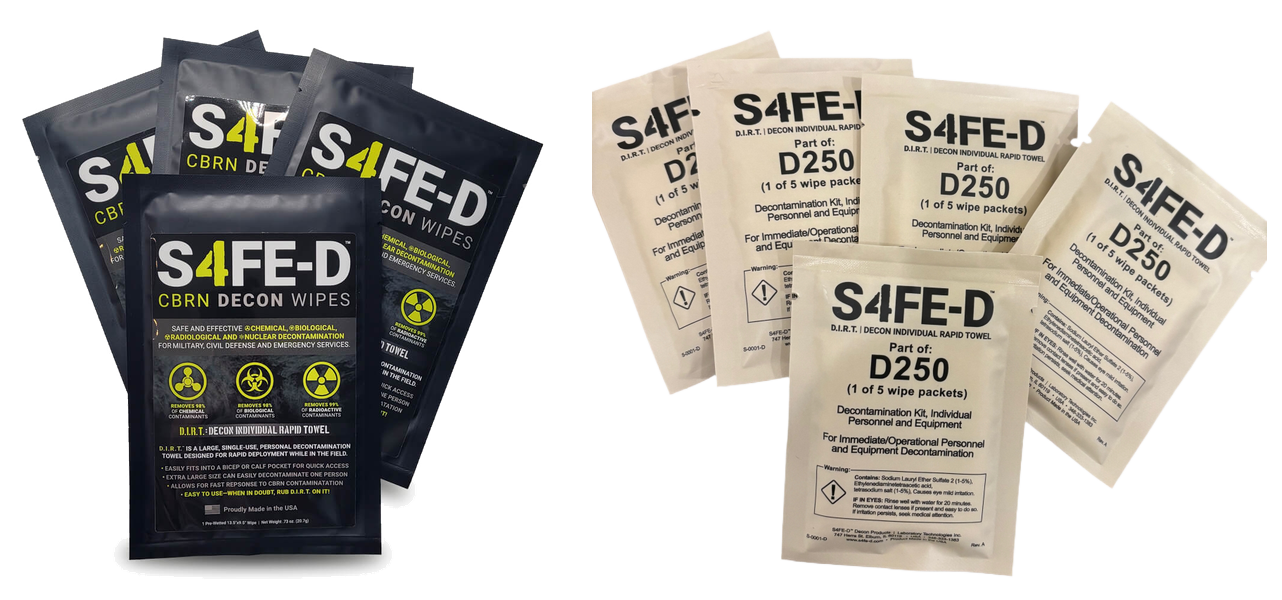
One extra-large pre-wetted wipe, sealed in a flat tear-open pouch — roughly the form factor of an oversized alcohol prep pad. Slips into a thigh pocket, calf pocket, plate-carrier admin pouch, BDU cargo pocket, or duty-belt pouch — without anyone noticing it’s there until the day it’s needed.
Pulled out the moment something questionable hits skin, gear, or surface. A chemical droplet during a vehicle search. A fentanyl-residue exposure during a drug-bust pat-down. A biological spatter during a patient transport. A hot spot detected on the forearm coming out of a perimeter sweep through a contaminated area. The decision tree at each event isn’t “what is it, what neutralizes it” — it’s just “pull out the wipe, wipe it down, drop it in a bag, move on.” Under a minute, contamination gone.
Same wipe. Different uniforms.


It also handles what the field actually throws at people on a routine day: blood, vomit, body oils, drug residue from evidence handling, urushiol from poison oak and poison ivy. And it’s been field-tested effective across the full riot-control-agent family — OC (pepper spray / capsaicin), CS, and CN — for officers, soldiers, and operators getting decontaminated after their team deploys any of the standard tactical irritants. Wind shifts, structure entry through gassed spaces, handling spent canisters, post-deployment PPE doffing — same wipe, same workflow. The same surfactant chemistry that lifts radioactive iodine off a hot lab benchtop lifts whatever’s on a glove, vest, or forearm. One mechanism, broad spectrum.
Same pouch wipes down weapons, optics, and gear. Sidearms, rifles, optics, plate carriers, helmets, gas masks — non-corrosive, won’t damage finishes, blueing, parkerization, or polymer. The post-event gear maintenance routine and the emergency decon protocol are the same product. Pull a wipe out after the callout to take lead, primer residue, and whatever else the day deposited off the duty weapon — no separate solvent kit, no chemistry that’ll eat a finish.


Pre-stage and forget. Each sealed pouch has a 48-month shelf life. Buy them once, distribute them across the patrol fleet, the medic bags, the plate carriers, the duty belts, the deployment loadouts; they sit ignored until the day they’re needed. Single use, single pouch, no maintenance, no temperature management.
The category vision: this is what naloxone became for opioid overdose — standard issue at the individual level for every soldier, marine, officer, EMT, and tactical responder. The cost of carrying one is effectively zero. The cost of not carrying one when it’s needed is incalculable.


Industrial chemical spills, hazardous drugs, fentanyl exposure response, occupational chemical contamination. Validated against common chemical surrogates in third-party testing.
Pathogen-laden surfaces from patient transport, EMS callouts, lab spills. Surfactant action lifts biological material into solution for capture on disposable wipes.
Radioactive iodine, technetium, cesium, strontium, and other isotopes on equipment, vehicles, PPE, and personnel. The original use case — over thirty years of hospital-validated performance.
Nuclear event cleanup, dirty bomb response, hot lab spill management, radiopharmacy incidents. Independently validated against fabricated radioactive fallout at Qal-Tek Associates: Tc-99m adsorbed onto micrometer-scale particles to match real fallout-particle sizes, deposited on aluminum surfaces, then cleaned with S4FE-D™. The report concludes the test brought surface contamination to background levels after one application.
S4FE-D™ was submitted to Qal-Tek Associates, an independent radiation safety and decontamination testing laboratory, for verified efficacy testing across the chemical, biological, radiological, and nuclear threat categories. The complete report is downloadable below.
Among the tests run: surface-applied Tc-99m on metal substrates (single S4FE-D™ application removed ~89%, three applications brought it to 99.2%), Glo Germ™ Oil and Mist (chemical and biological simulants, averaging 98.6% removal in a single application), and a fabricated nuclear fallout test where Kelley Williams at Qal-Tek adsorbed Tc-99m onto micrometer-scale particles to match real fallout-particle sizes, then cleaned the resulting contamination off aluminum. The report's conclusion on that test: "brought surface-contaminated aluminum to background levels after one application."
Independent validation matters in CBRN procurement. Agencies and military programs don't accept manufacturer-claimed efficacy numbers. The Qal-Tek report carries the third-party signature your procurement and safety officers need to defend the line item.


Every S4FE-D™ form factor uses the same active chemistry. Choose by the mission profile — pocket-carry personal decon, vehicle / kit-stowed bulk, or pre-staged incident response.
Decon Individual Rapid Towel — one extra-large pre-wetted wipe per tear-open pouch. Sized to fit in a thigh, calf, or bicep pocket for personal decontamination in the field. Pre-stage and forget — 48-month shelf life sealed. Same pouch in two configurations: civilian 4-pack and Mil Spec D250 5-pack with a stronger formula concentration for defense and government procurement.
Ready-to-use 32 oz spray bottles and pre-wetted wipe canisters (50 or 80 count) for equipment, vehicles, hard surfaces, and PPE. Spray, dwell 30 seconds, wipe with paper towel, throw away. No rinse required for most surfaces. Bulk Ready-to-Use spray also available in 55-gallon drums and 275-gallon totes for fixed-site or large-fleet decon programs.
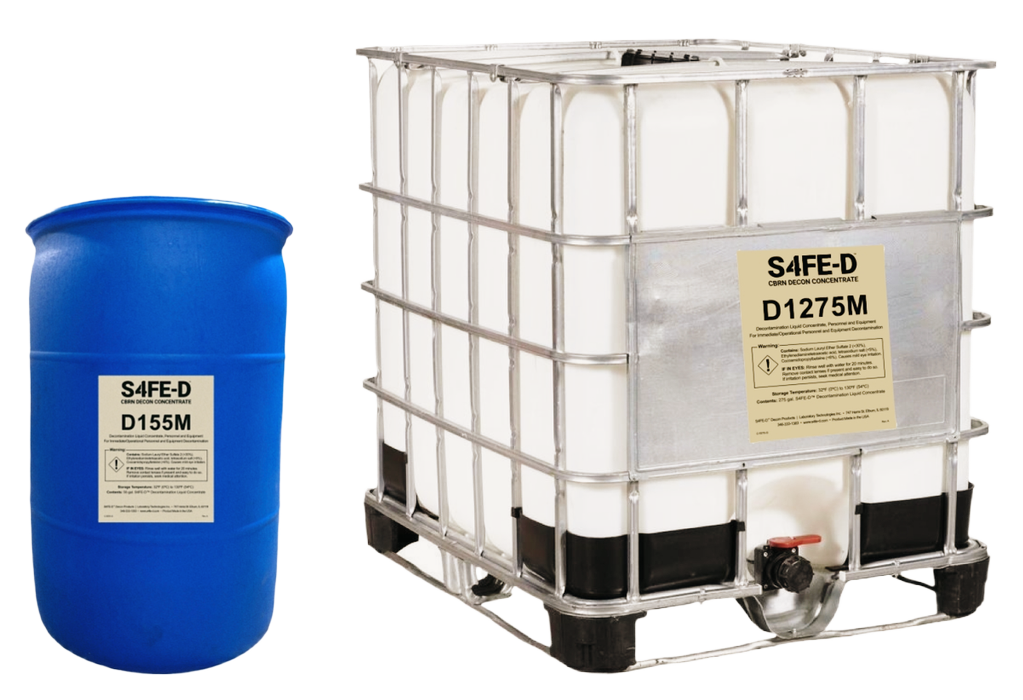
From 16 oz Mil Spec bottles up to 55-gallon drums (D155M) and 275-gallon IBC totes (D1275M). Mix on-site at roughly 1:10 with water for large-area decon, vehicle wash-down, or hot zone perimeter treatment. The bulk SKUs are the same chemistry as the ready-to-use spray — scaled for fixed-installation, motor pool, or wide-area response.
Skin-safe, gentle formulation for hand washing after handling contaminated items and for shower / body decon following PPE doffing. Same active chemistry as the spray, in a skin-safe surfactant base. Available in 16 oz pump bottles (civilian and Mil Spec D416M).
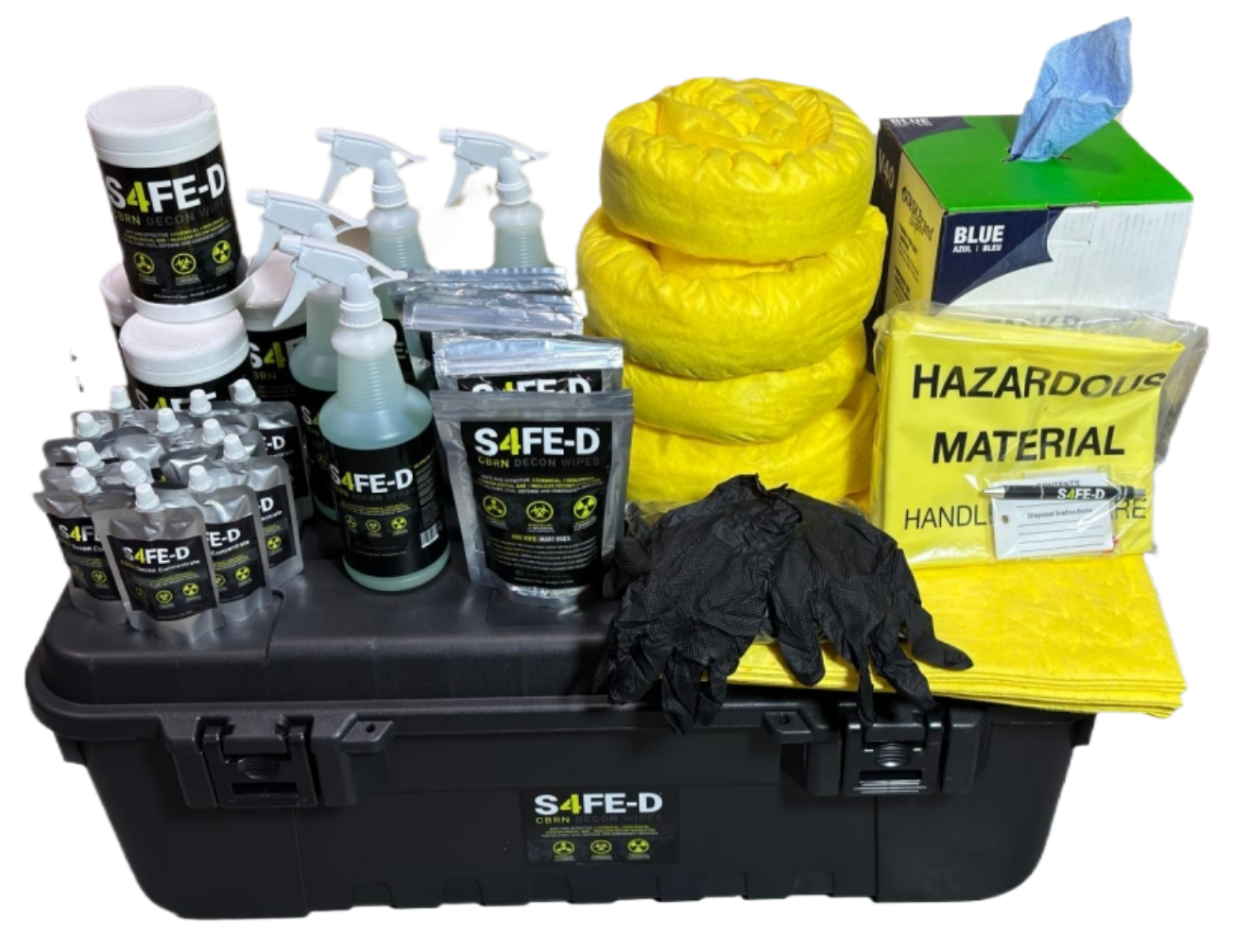
The grab-and-go response trunk. Packaged in a Plano Sportsman's Trunk with all four S4FE-D™ forms factors, absorbent pads, hazmat waste bags, gloves, and shop towels. Available in three configurations: Base Kit, Cordless Spray add-on (for large-area deployment), and PPE add-on (Tychem suit + face shield + N95). Built for fire and EMS, civil defense, hot lab response, and industrial emergency teams.
The Bind-It™ chemistry inside every S4FE-D™ product was developed by Laboratory Technologies in the early 1990s for a specific clinical problem: removing radioactive iodine from hospital surfaces without volatilizing it. Bleach turns iodine into vapor and spreads contamination; the surfactant binding formulation traps it in liquid so it leaves on a paper towel.
Thirty years of hospital, nuclear pharmacy, and research laboratory use later, the same active chemistry has been validated for the broader CBRN threat picture — chemical contamination, biological exposure, radiological and nuclear material. The transition wasn't a reformulation; it was a re-deployment. The chemistry already worked. We just sized the packaging, the kits, and the documentation for the responder community.
That heritage is the answer to the "why this, not the commercial decontaminant we've been buying" procurement question: three decades of validated clinical use is a trust signal a five-year-old commercial product can't match.
Vehicle decon, equipment cleanup, personal-decon pocket carry, pre-staged response kits at forward operating locations. The same kit handles a chemical exposure event, a biological agent surface, or a radiological dispersal scenario.
DHS, FEMA, state radiological emergency response teams, civil defense agencies. Pre-staged DRK trunks at strategic locations for rapid deployment after dirty bomb, industrial chemical release, or unknown-substance scenarios.
Truck-stowed for spill response. EMS hot-patient decon between transports. Apparatus decon after an unknown-substance call. Skin-safe formulation makes it deployable on personnel as well as equipment.
Routine I-131, Tc-99m, F-18 cleanup in radiopharmacy and nuclear medicine departments. Hot lab spill response. Reactor maintenance contamination control. Scientific and industrial isotope handling.
Fentanyl exposure response, evidence handling after suspected CBRN incidents, vehicle decon following high-risk traffic stops. Compact DIRT towels in patrol-officer pocket carry.
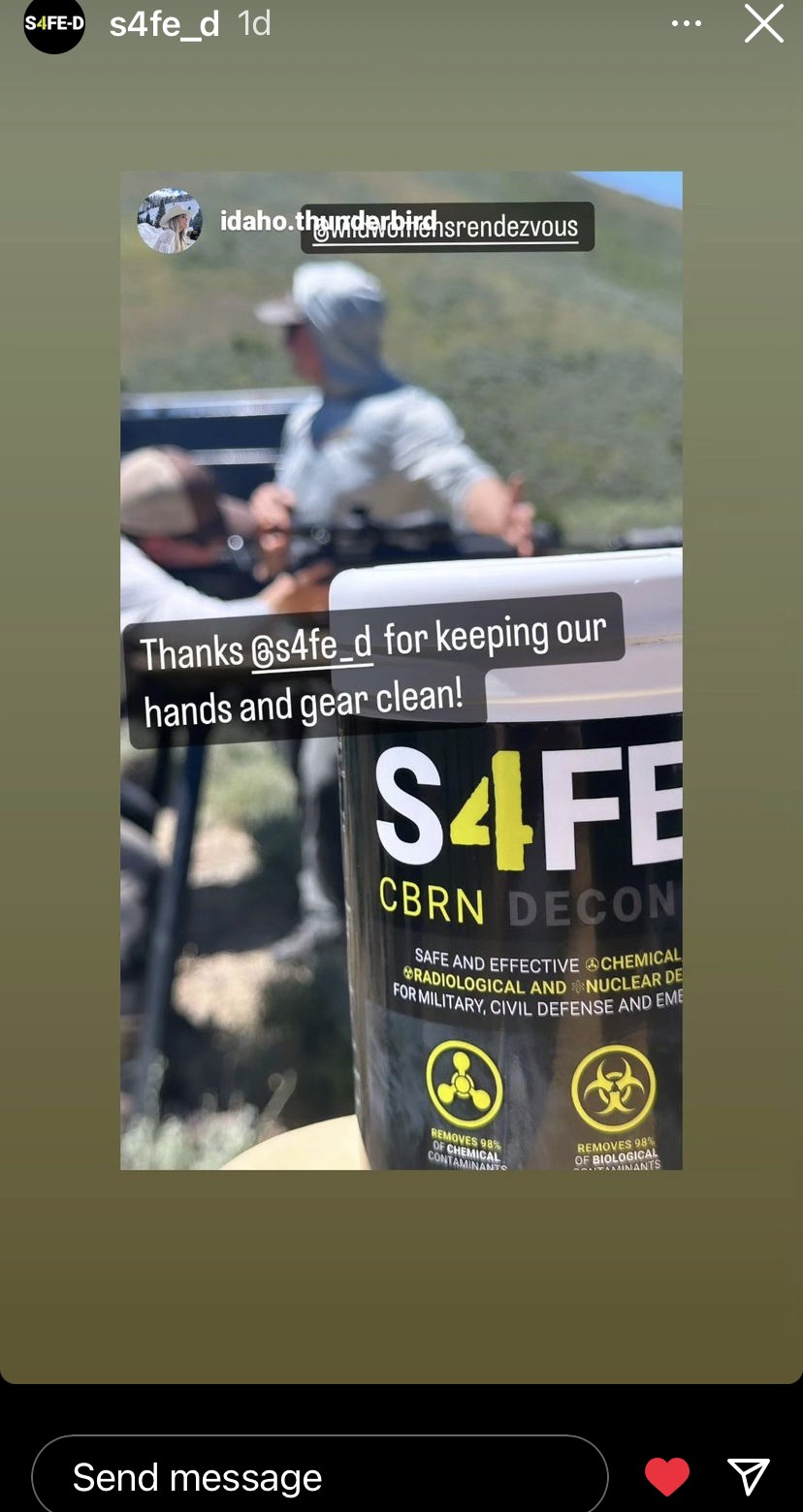
Lead, antimony, and primer residue on benches, equipment, and shooter hands. The same surfactant binding chemistry that handles I-131 in a hot lab handles heavy-metal residue on a range. Deployed at the Thrival Foundation’s Wild Women’s Rendezvous (Ashton, Idaho) for post-range hand and gear decon during their multi-day women’s firearms training program, and by large US indoor and outdoor ranges for routine bench cleanup.
Authorized distribution and training programs in Europe, Asia, the Middle East, and the Americas. International CBRN responders trained on the same chemistry deployed by U.S. agencies — including registration with the Taiwan Ministry of National Defense and active training programs with the Philippine military.
Federal, military, and government buyers can purchase the full S4FE-D™ line on contract through ADS Inc. (Atlantic Diving Supply), our authorized GSA reseller. Every S4FE-D™ product is listed on GSA Advantage.
Searching GSA Advantage: enter “S4FED” (one word, no hyphen) or “Laboratory Technologies.” The hyphenated form “S4FE-D” may not return results.
A growing library of imagery from S4FE-D™ field deployments, international CBRN training seminars, and trade show demonstrations.
Mike Glover’s Fieldcraft Survival — a major US tactical training company — featured S4FE-D™ in one of their Instagram reels. The shoutout reached the prepping, EDC, and tactical communities that overlap heavily with the CBRN responder audience.
Live demonstrations of the S4FE-D™ product family alongside complementary CBRN detection equipment at international defense trade shows.
A winter tactical operator’s kit, posted by Avon Protection — one of NATO’s flagship CBRN gas mask manufacturers — on their official Instagram. The S4FE-D™ D.I.R.T. Mil Spec wipe pouch (the actual product, not a patch) is deployed on the chest rig alongside the operator’s Avon mask, night vision, and tactical comms.
From the Thrival Foundation’s Wild Women’s Rendezvous in Ashton, Idaho — a multi-day women’s outdoor and firearms training program. Posted by @idaho.thunderbird at the rendezvous: S4FE-D™ Wipes used for hand and gear decon after a day of shooting on the range.
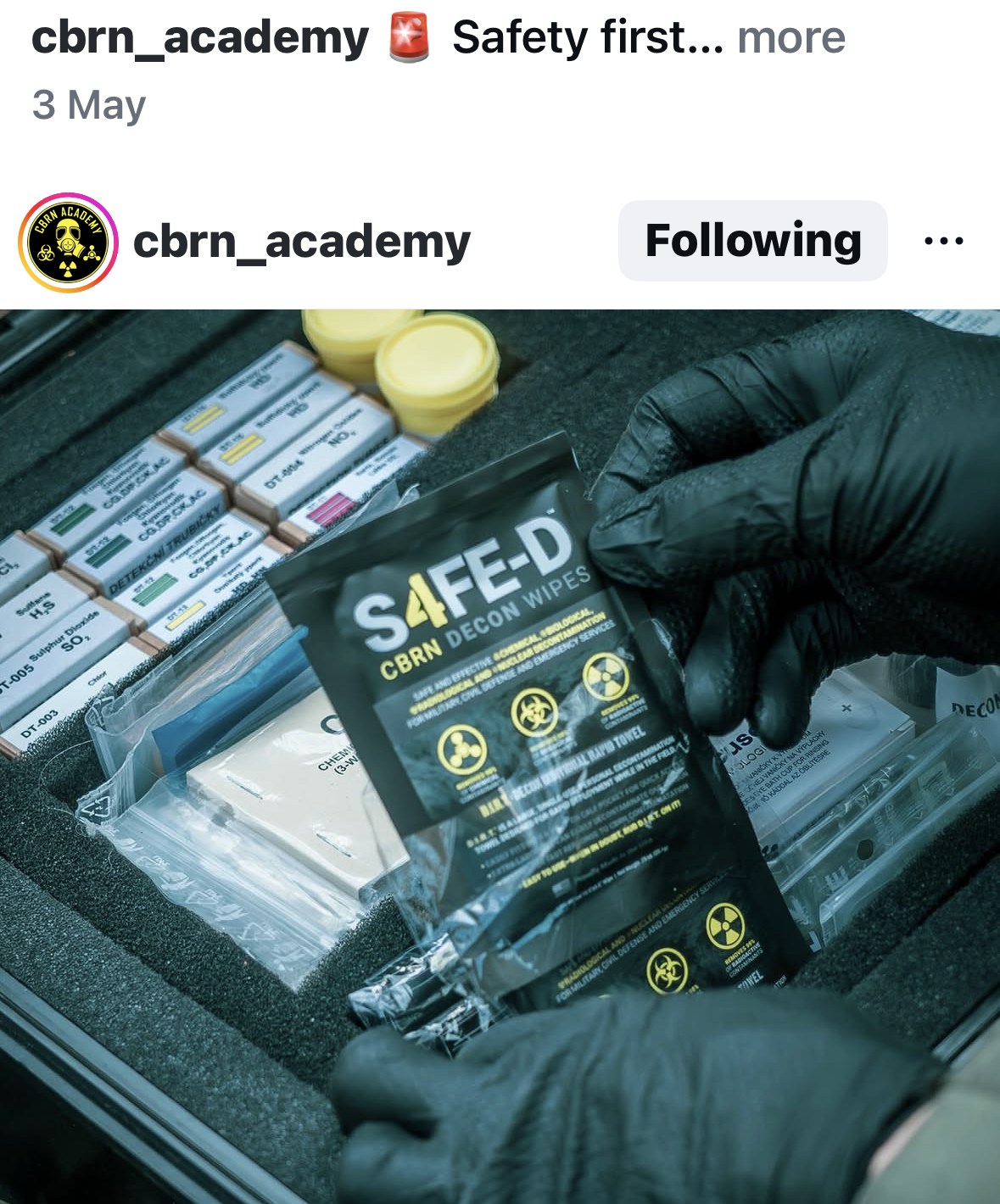
CBRN Academy — a civil-defense gear review channel followed by professionals and first responders — adds S4FE-D™ CBRN Decon Wipes into a tactical kit build on their Instagram. Decon completes the kit; without it, the kit is missing the cleanup step.
A tactical operator’s chest rig: the S4FE-D™ D.I.R.T. Mil Spec wipe pouch (the actual product, mounted on the rig — not a brand patch) alongside an Avon Protection patch and the American flag. Caption: “If you are in a situation where you have to gear up, think ahead. S4FE-D CBRN D.I.R.T. Wipes are a quick, easy and...” — with a fire-emoji reply from @avonprotection’s official account.
Avon Protection — the NATO-trusted CBRN gas mask manufacturer — commented publicly on an S4FE-D™ Instagram post: “Outstanding product!” The same Avon Protection whose flagship masks pair with S4FE-D™ D.I.R.T. on the tactical loadouts above.
A police tactical operator’s loadout — POLICE-marked plate carrier, full CBRN gas mask + helmet with NVG mount, and the S4FE-D™ Mil Spec wipe pouch mounted on the rig. The same surfactant chemistry hospitals have used for thirty years, sized into a pouch that fits between a magazine and a radio on a duty rig.
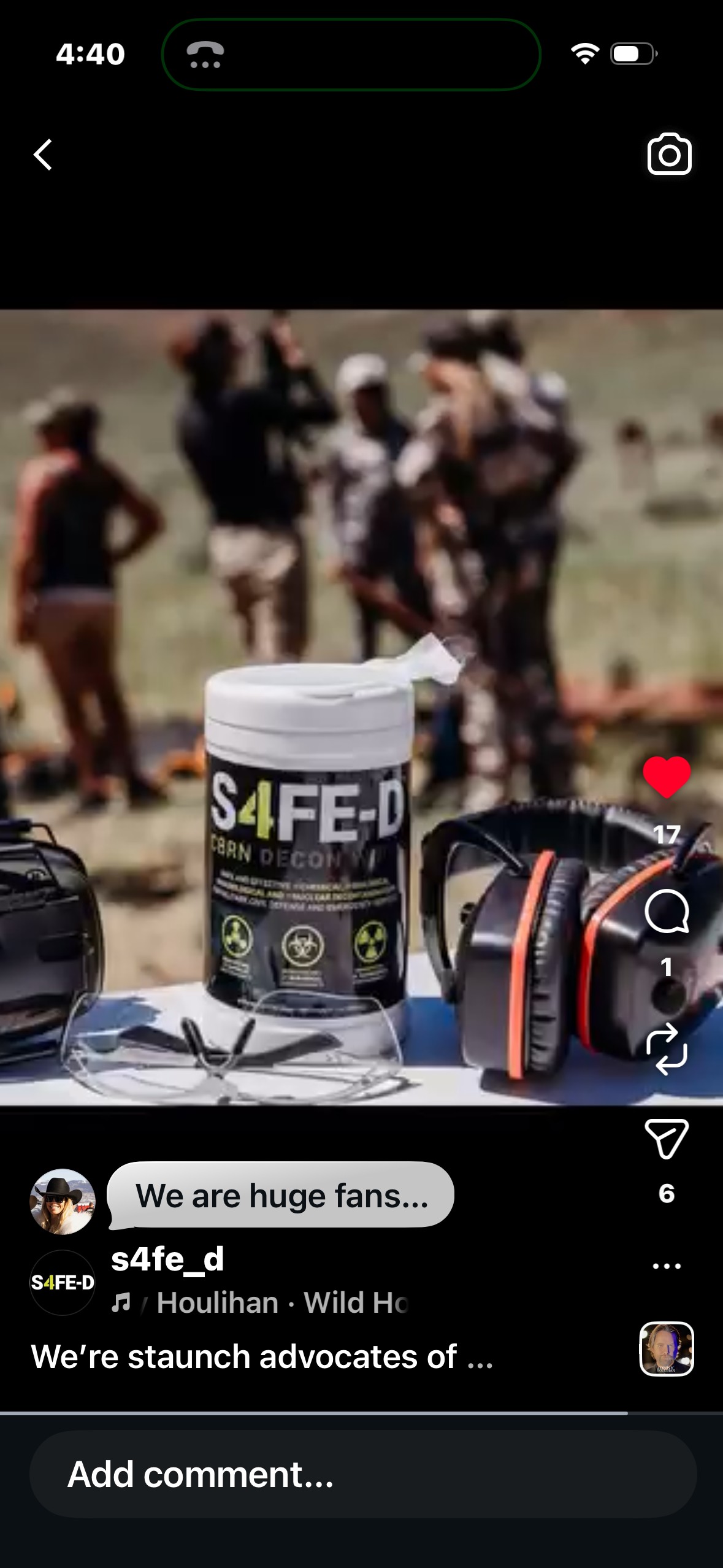
An S4FE-D™ CBRN Decon Wipes canister and tactical ear protection on the bench at an outdoor pistol training event, shooters working in the background. The caption: “We are huge fans… we’re staunch advocates of…” — lead, antimony, and primer residue cleanup is the same surfactant-binding chemistry that handles I-131 in a hot lab.
Live deployment in a National Guard WMD training exercise, hands-on demonstration by an independent CBRN reviewer, and a sponsorship partnership with the active-duty US special operations community.
Full product family overview, applications, and specifications.
Download ↓Independent validation of decontamination efficacy across CBRN surrogates.
Download ↓Collaboration with CBRN HQ — deployment guidance and field considerations.
Download ↓The Decon Response Kit deployment overview — configurations and use case map.
Download ↓OSHA-format SDS for procurement, safety review, and regulatory files.
Download ↓Radiological-specific application reference — isotope coverage, surface guidance, deployment notes.
Download ↓Whether you're standing up a new program, refreshing an existing decon protocol, or evaluating S4FE-D™ against your current supplier — reach out and we'll connect you with the right resource. Distribution is handled regionally; we'll route you to the closest authorized partner or work with you directly if you prefer.