From a single founder’s bench to instruments running in nuclear medicine departments around the world — still family-run, still built by hand in the Chicago area where we started.
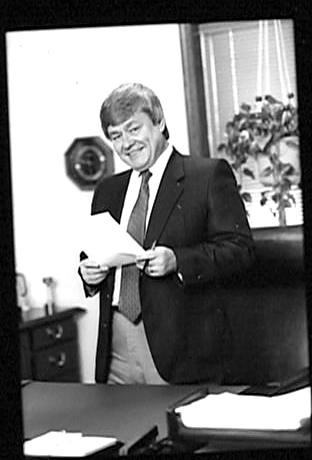
LTI · Schaumburg, Illinois · c. 1986
1983 · The Beginning
It started with one engineer and a better idea.
Donald Oesterlin walked away from a very successful career at Nuclear Chicago (now part of Siemens), where he had been the lead engineer and held multiple patents on gamma counter designs. Frustrated with the instruments his colleagues were forced to use, he decided to build something better.
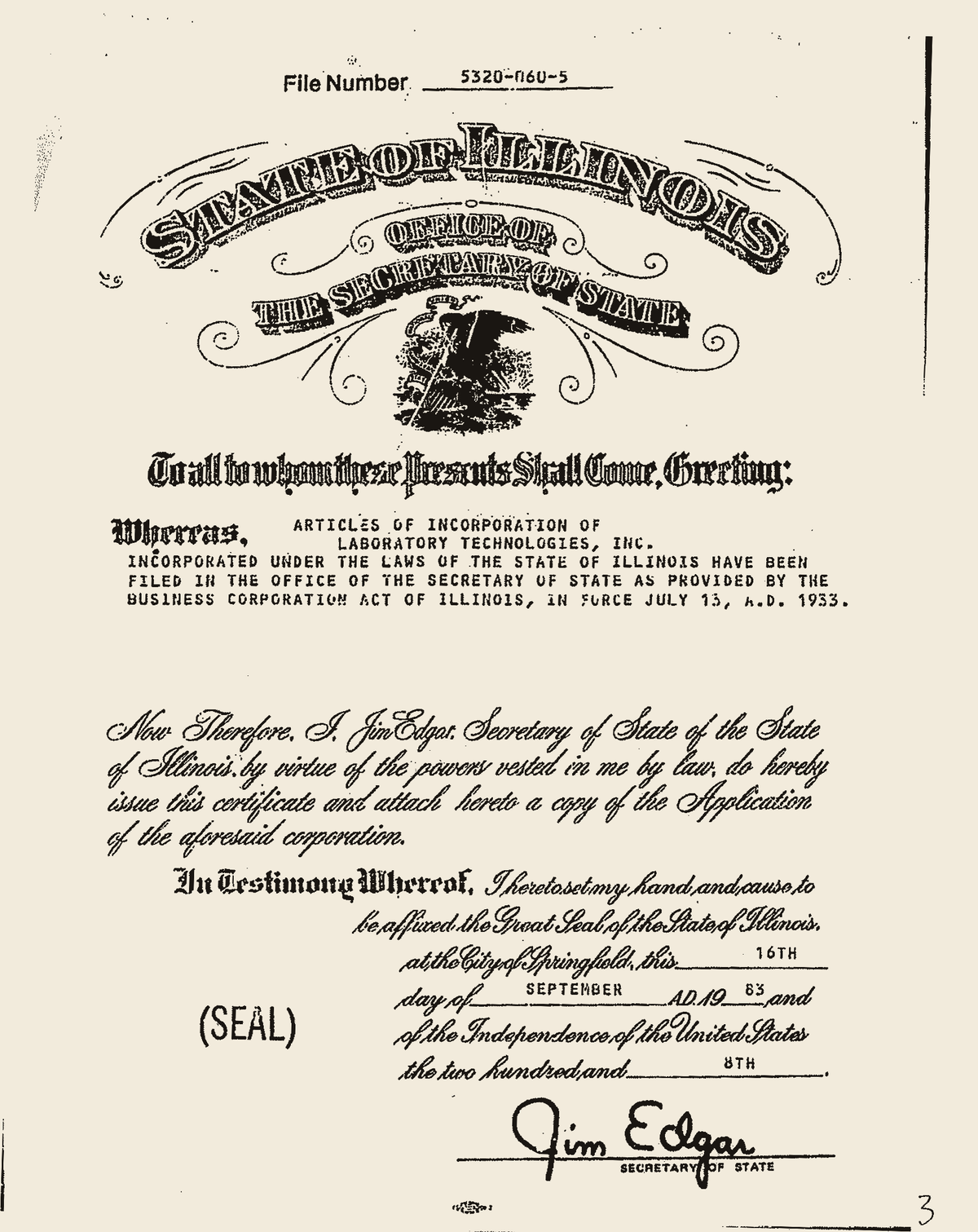
On September 16, 1983, Donald filed the Articles of Incorporation for Laboratory Technologies, Inc. from his family home in Elburn, Illinois — making Elburn LTI’s very first operating address. As soon as the work outgrew the kitchen table, the company moved out into a real building. A long stretch in Schaumburg followed (where the original Genesys came together), then Roselle, then eventually back to Elburn — where we sit today, a few miles from the house where it all started forty-plus years ago. One region. The same family.
The bet was simple. If you put real engineers under one roof, give them the freedom to design things the way they should be designed, and stay close enough to your customers to actually pick up the phone, you can build instruments that last decades. Forty-plus years later, that’s still the bet we’re making.
The crew Donald assembled in those early days wasn’t a generic engineering team hired piece by piece. It was a specific group of people, each shaped by a specific path through the second half of the twentieth century — and the standards they brought to the bench are still embedded in every instrument we ship today. A couple of their stories are worth telling.
Certificate of IncorporationState of Illinois · September 16, 1983Filed under the Business Corporation Act · Signed by Secretary of State Jim Edgar
The Original Crew
The hands that built it.
The instruments LTI ships today started on a workbench in those early Chicago-area days, in the hands of a small group of engineers Donald hired in the first years of the company. Two of them, in particular, are worth knowing about — their backgrounds tell you most of what you need to know about why our products are built the way they’re built.
The Chicago computer pioneer.
One of Donald’s earliest hires was a hardware engineer who’d come up through the Chicago-area computer industry in the 1960s and ’70s — a true pioneer of the early digital era. Back then, the right-sized component for a job often didn’t exist yet. So engineers built it themselves.
He and his wife used to spend evenings at the kitchen table hand-assembling magnetic core memory — threading thousands of tiny ferrite rings, each barely a millimeter across, with wires so fine you needed a magnifying glass to see them. One ring, one bit. A few thousand rings, painstakingly wound by hand, made a working memory module for an early computer. They were doing the work the early computer industry literally couldn’t source from anyone else, because nobody made it yet.
Decades later, that same patience — for impossibly small, impossibly precise work — showed up on the circuit boards inside our Genesys gamma counters. The first generation of LTI instruments was designed by an engineer who’d literally hand-built memory one bit at a time. It shows.
The old-world mechanical engineer.
Another founding-era engineer came to the United States from Germany after the Second World War. As a young man he served as one of Rommel’s personal bodyguards in the Afrika Korps. He returned home missing his pinky finger — lost in combat — but also with an uncompromising standard of mechanical precision that became part of LTI’s DNA.
That precision became part of how our instruments were built. If a chassis had to fit within a thousandth of an inch, it fit. If a bracket needed to hold a detector still under temperature swings for a decade, it held. If a service technician was going to be opening this thing up at three in the morning twenty years from now, the screws would be where they were supposed to be, in the order he was expecting to find them. Mechanical discipline, the old-world kind, doesn’t go out of style — it just gets harder to find.
That’s the company Donald started building around in 1983. Not an org chart — a few people, each with their own decades of work and their own deeply held opinions about how things should be done. Some of those engineers have long since retired. Others are no longer with us. But the standards they set on day one — for precision, for patience, for taking the time to do it right — became the bar everyone who walked in after them was expected to clear. Forty-plus years on, that’s still the bar.
Built here. By hand. Since 1983.
The bench did the talking.
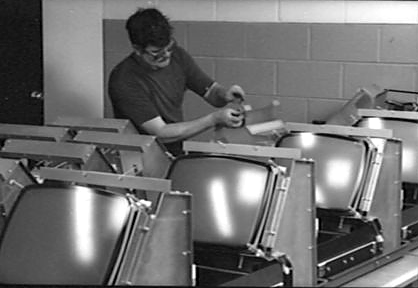
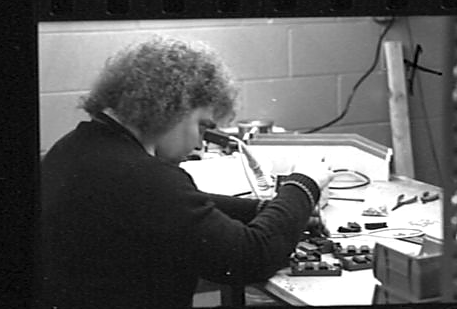
A few frames from the LTI production floor, mid-to-late 1980s — the people, the place, and the work that defined the way we build instruments today.
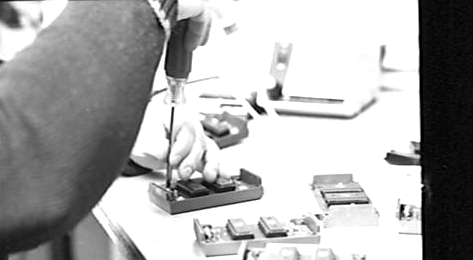
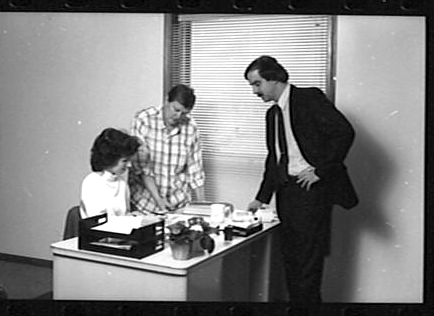
Genesys™ 5000 assembly line — hand-built, one unit at a time. Then and now.The bench — circuit boards built with a magnifier-light, a soldering iron, and patience.Sub-assembly detail — the kind of close-in work that doesn’t scale, except by hiring people who care about it.The office — small enough that the people answering the phone knew the people on the bench.
1984–1995 · The Genesys Heyday
The instrument that built the company.
Roughly two years after we opened our doors, we shipped our first product: the Genesys™ 5000 Series multi-well gamma counter. The first units delivered in late 1984 and early 1985, sized as 5-, 10-, 15-, 20-, and 25-well configurations — banks of five wells, scaled to whatever the lab’s throughput called for. The 10-well and 25-well became the workhorse sizes.
The entry-level 5-well version shipped at under $10,000. For a clinical multi-well gamma counter in 1985, that was a price point that blew the market wide open. The 5000 was designed for the clinical laboratory — with software far ahead of anything else on the market and one of the very first touch screens in nuclear instrumentation.
The software was, in fact, so far out in front of the available tooling that during development our engineers were on the phone with Microsoft’s compiler team almost daily. We kept finding bugs in their compilers. We kept needing language features that didn’t exist yet. They kept shipping patches around the corner cases our code generated. Microsoft was a much smaller company in those days, and we got to know the people on that team well — we were one of the more aggressive real-world workloads they had to handle, and our nuclear medicine instrument was forcing tooling decisions Redmond hadn’t had to make yet. Some of the features that landed in their compiler in the mid-’80s are there because a small engineering team in Illinois kept breaking the previous version.
By 1988 the Genesys was widely recognized as the best multi-well gamma counter in the world.
Genesys™ 5000. Angled CRT with on-screen virtual keypad, external sample tray, integrated printer output — the late-1980s shape of clinical multi-well counting.
One of the earliest serious customers was the United States Navy. From our Schaumburg facility we held a contract supplying Genesys gamma counters to the medical center at Naval Station Great Lakes — the Navy’s largest training command, on the lakefront just north of Chicago. Naval Admirals drove down to the plant in person to walk the production floor and sign off on the procurement themselves before the contract could close. For a small Illinois engineering company two years out of the gate, having uniformed officers from the Department of the Navy inspecting your assembly line was a serious thing — and a signal of what the Genesys was about to become.
Word traveled fast in the clinical world. The Genesys started showing up in clinical laboratories, oncology departments, and isotope manufacturing facilities. SmithKline, MetPath, and Quest — the largest reference labs in the country — were among the customers. At MetPath, the operator who described their bench put it this way: “Looking down the bench, all you could see was stacked Genesys 5000s.” Multiple 25-well units lined up side-by-side, processing thousands of patient samples a day to keep up with the high-volume RIA workload of the era.
Two commercial structures kept the units shipping. We licensed the platform to Ciba Corning as a reagent rental — their sales reps would sign labs into reagent-supply contracts, and a Genesys 5000 went with the deal: instrument placed in the lab at no cost if the customer committed to the reagents. Kept the LTI badge, kept the LTI service relationship. Separately, Organon Teknika Corporation sold the Genesys 5000 under their own brand as the OTC 7000 — beige paint, OTC sticker, on-screen company label changed from “Laboratory Technologies” to “OTC”; otherwise identical. Everyone in the industry knew the OTC 7000 was a Genesys 5000; it was an open-arrangement distribution play, not a secret white-label. Two commercial models, one machine, thousands of units shipped worldwide.
LTI at an industry trade show, late 1980s. The competitive landscape of the era visible in the background — DuPont and other major vendors. Four decades later, many of the names on those booths are gone. LTI is still in Illinois.
For the very largest labs — the ones the 25-well 5000 couldn’t keep up with — we built the Genesys™ 6000. Same engineering lineage, new chassis: 50 to 75 percent larger than the 5000, available in 10-well banks up to 60 (10/20/30/40/50/60). The 30- and 60-well configurations were where the actual sales lived; the smaller 6000 configs existed in the catalog but the 5000 still made more sense for any customer needing under 30 wells. The chassis was large enough that we field-assembled the units on customer site — the lead shielding mass made full pre-assembly impractical to ship.
Genesys™ 6000. A new chassis built for the labs that needed throughput the 5000 couldn’t match. Separate sample-loader unit, graphical efficiency display on the console CRT, external keyboard. Field-assembled on customer site because of the lead shielding mass.
The end of the heyday — and what survived it. When the high-volume RIA boom faded across the clinical industry in the mid-1990s, the 6000’s specific use case faded with it. We retired the 6000 not because the product had failed — it had sold to the largest reference labs in the country — but because the workflow that justified its scale was no longer the way clinical labs ran. Market evolution, not engineering failure.
The last Genesys 6000 we know of in active service was a 30-well unit at William Beaumont Hospital in Michigan, running well into the early 2000s — another fifteen-plus years of useful service out of a discontinued instrument. The 6000 sold to the biggest labs in the country; it kept running long after we stopped building it. That’s the part we’re most quietly proud of: thousands of Genesys 5000s and 6000s shipped in the 1980s and early 1990s, and many of them are still running today. The Genesys 5000 — under either badge — remains on our active service list.If you have one, we will keep it running.
1995 – 2005 · The Wiper Era
Built specifically for nuclear medicine.
In 1995, we designed the Wiper™ — our first instrument aimed squarely at the nuclear medicine department. Until then, hot labs were doing wipe surveys on whatever counter happened to be available, often a Genesys originally meant for clinical assays. We built the Wiper from the ground up around the actual workflow of a busy nuclear medicine department, with isotope identification down to a quarter of a keV in resolution.
A decade later, in 2005, we did it again — only this time we built the world’s first gamma counter designed specifically for the nuclear medicine department: the Multi-Wiper™. Up to ten wipes counted simultaneously, individual isotope ID per wipe, MDA reporting, pass/fail results — the work of a morning compressed into a few minutes. Today the Multi-Wiper is the flagship of our nuclear instrumentation line.
The latest evolution, the Wiper™ Gold, was designed around a different question: what would a wipe counter look like if it were built specifically for the workflows of nuclear pharmacies and cyclotron customers? The answer is a feature set most counters don’t ship — forward and reverse decay calculation (the activity that sample had three hours ago, calculated automatically), sample-volume correction across multiple dilution points per isotope, iterative counting for trace-level work, and an unusual dynamic range that scales from the smallest detectable count rate up to eighteen million CPM. At the center is the feature that puts it in a category by itself: a true 4096-channel multi-channel analyzer (MCA) built into the instrument — region-of-interest selection, peak ID, FWHM, baseline subtract, full Pulse Height Analysis. No other wipe-test or well counter on the market ships with that capability built in. A single bench-top instrument doing what most labs used to need a rack of equipment for — and what some never had the budget to do at all.
Recognition · 2012
The textbook every nuclear medicine technologist trains on.
The Essential Physics of Medical Imaging by Dr. Jerrold Bushberg is the standard reference work for medical imaging physics — used in U.S. nuclear medicine residencies, medical physics graduate programs, and ABR / ABNM certification prep. When the third edition was published in 2012, the gamma counter Dr. Bushberg chose as the example illustration for the section on multi-well well-counter design was the LTI Multi-Wiper.
Three pieces of LTI source material went into that figure: this annotated technical drawing of the detector array (produced by our engineering team), a captured display screen from a working Multi-Wiper, and a real wipe-test report. Bushberg’s editorial team composed those three into a single page. We’re proud the drawing was good enough to be selected. We’re prouder that the instrument was the example chosen.
The drawing above is the original LTI illustration. The composite page in the textbook is copyright Wolters Kluwer; we don’t reproduce it here.
1990 – Today · Decontamination
From hot labs, to homes, to first responders.
1990 — A problem with our own detectors.
Bind-It started as a problem we were having with our own equipment. By the late 1980s our service technicians kept coming back from the field with the same complaint: customers were trying to clean radioactive iodine out of their gamma counter detector wells with whatever was under the sink — harsh laboratory cleaners, aggressive solvents, chelating agents, anything that looked like it would scrub off the iodine. The cleaners that worked on iodine were also reactive with aluminum, and aluminum is exactly what shields the NaI(Tl) crystal inside a gamma counter detector. The cleaners attacked the housing first, dissolving the metal and eventually breaching it. Once the protective barrier was gone, the crystal underneath degraded fast. We were rebuilding instruments that didn’t need to be rebuilt.
So our chemists set out to develop a cleaner that could do the actual job — safely lift radioactive iodine off a surface — without attacking aluminum, anodized surfaces, or any of the bonded substrates the rest of the detector assembly was made of. The chemistry they came up with worked by binding the contamination rather than neutralizing it or killing it. The radioactivity ended up in the wipe instead of in the air, in the drain, or on a detector housing. We called it Bind-It™.
It didn’t take long for customers to start asking us to bottle and sell it. By the mid-1990s, Bind-It was the chemistry hospital hot labs and nuclear pharmacies trusted for radio-iodine cleanup. Thirty-plus years later, that’s still true.
The phone call.
In late 2010 we got a call from a woman whose husband had just come home from a thyroid cancer hospital after I-131 therapy. He’d been radioactive enough to require an inpatient room with shielded walls; now he was sitting in their kitchen. She had somehow tracked down a manufacturer of nuclear medicine instruments in Illinois because the discharge instructions she had been given essentially read “flush the toilet twice and try to sleep in another room for a few days.” She wanted to know what to actually do.
We didn’t have a good answer for her that day. But the call sat with us, and we started looking into how I-131 patients were being sent home from hospitals across the country. Her experience, it turned out, was the norm rather than the exception. Iodine doesn’t sit politely after therapy — it leaves the body through urine, sweat, saliva, and tears, and it contaminates whatever it touches: faucets, door handles, sheets, dishes, the inside of a pillowcase. Most hospital discharge handouts didn’t really acknowledge that, and online patient forums were filling the vacuum with advice that ranged from useless to actively dangerous (a few were recommending bleach, which volatilizes iodine and spreads it through the air).
We didn’t love that situation. So we did the two things we could actually do. We pushed Bind-It harder into nuclear medicine departments, so the chemistry that had been protecting our detectors could also protect the patients leaving those departments. And we wrote a real, plain-language home cleanup guide — written for a worried spouse, not a regulator — and packaged Bind-It in family-sized quantities to match. That’s our Home Isolation Kit.
The woman who called us in 2010 never got the version of the kit we eventually built. But every patient and family who’s called since has.
Putting numbers on the chemistry.
In 2023 we sent Bind-It to the best independent testing lab in the country to find out exactly how well it works. With a few small adjustments to the formula, we relaunched it as S4FE-D™ CBRN Decontaminant — the same chemistry, now independently verified to remove up to 99% of radioactive contamination, 98% of biological contamination, and 98% of chemical contamination.
In 2024 we partnered with a new distributor to bring S4FE-D into industries we hadn’t served before — civil defense, military, law enforcement, fire and rescue, EMS. The product is the same. The audience just got a lot bigger.
From the Archives · 2014
The original patient‑care‑pack commercial.
In 2014, when this product was still named Bind-It™, we produced this short patient-facing demo to walk thyroid‑cancer families through what to do when their loved one came home from I‑131 therapy. The chemistry hasn’t changed. Today the same product ships as the S4FE-D™ Patient Care Pack — same formula, now independently verified to remove up to 99% of radioactive contamination.
Twelve years on, the patient experience this video describes — coming home radioactive, worrying about contaminating your kitchen, your bathroom, the people you love — is unchanged. So is our answer to it. The bottle on screen says Bind-It; the bottle on your shelf today says S4FE-D. The chemistry between them is the same.
Forty-Plus Years
A few of the milestones.
1983LTI incorporated September 16 — at Donald’s home in Elburn
1985Genesys™ 5000 ships — our first product
1988Recognized worldwide as the best multi-well gamma counter
1990Bind-It™ chemistry developed for radio-iodine cleanup
1995Wiper™ launched — first counter built for nuclear medicine
2005Multi-Wiper™ — the world’s first dedicated nuclear medicine gamma counter
2010Home isolation guide and patient-sized Bind-It kits
2023Independent testing & relaunch as S4FE-D™ CBRN Decontaminant
2024S4FE-D expands into civil defense, military, fire, EMS
Today · Family-Owned, American-Made
Three generations in. Still in Chicagoland.
LTI is still a privately held family company, now under the leadership of Jeffrey Oesterlin. We still design and manufacture every product in the United States. We still pick up the phone when our customers call. The combined experience on our floor adds up to centuries — and most of it has been spent here, at LTI, building the same kind of instruments we’ve always built.
Today our products are used daily by the largest nuclear pharmacies and radiopharmaceutical manufacturers in the United States, top-ranked cancer centers, VA hospitals, U.S. Army medical facilities, and research institutions in more than 43 countries. The bet Donald made in 1983 turned out to be a good one.
Still Building · Today & Tomorrow
Forty-three years in, and we’re still the manufacturer that prefers a CAD edit to a tooling order.
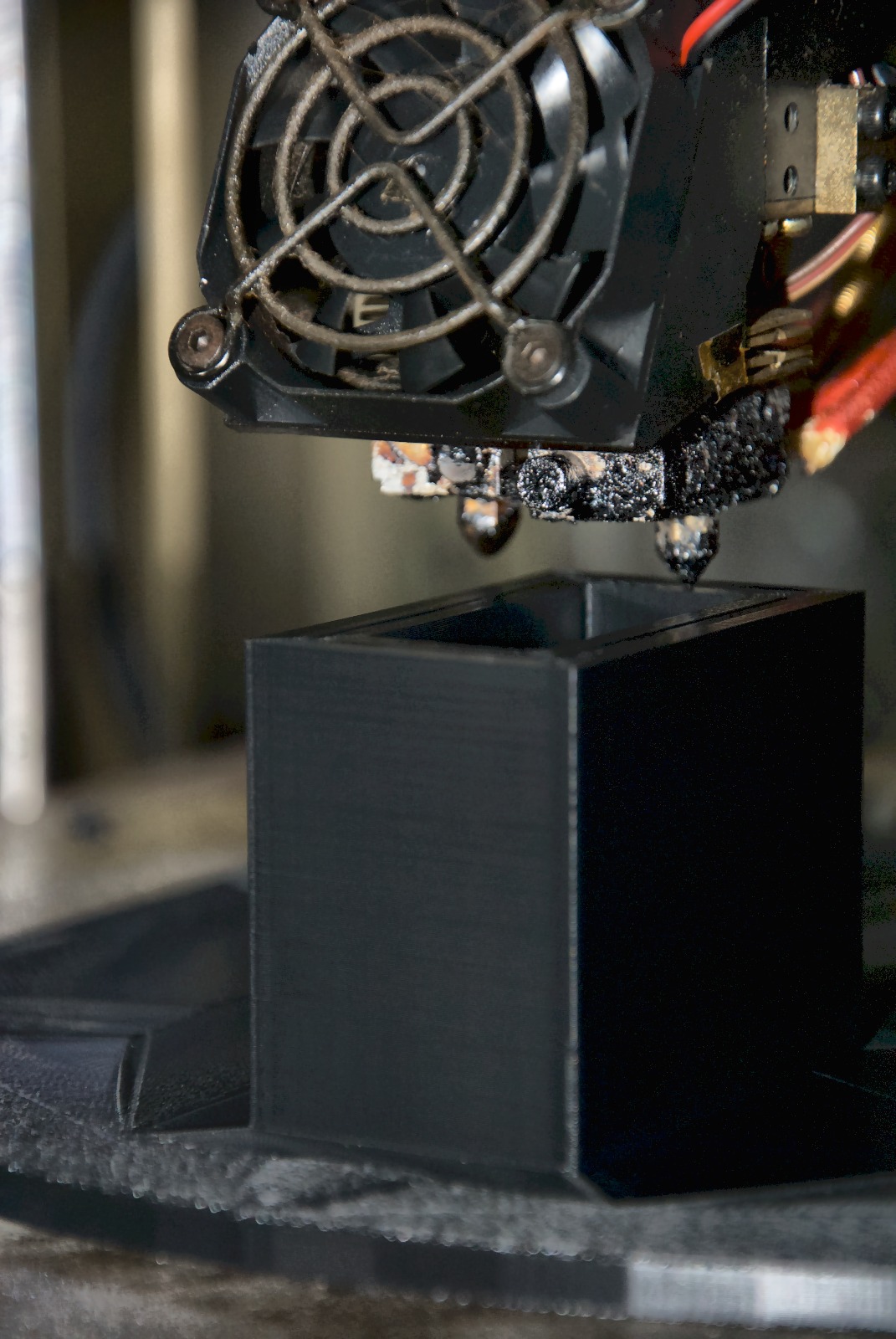
The longer a company is in business, the louder the temptation gets to coast on what worked twenty years ago. We don’t. Some of the most consequential changes to how we build instruments have happened in the last five years — specifically, the decision in 2020 to bring detector-housing production in-house onto an industrial-grade additive manufacturing platform. Raise3D published a case study about that switch in 2021; the headline numbers were a 75% reduction in housing-build cost, a 10-pound weight savings per unit, and the same structural strength as the cold-rolled steel it replaced.
The headline numbers matter, but the operational reality matters more. When our engineers improve a part — a better connector cutout, a relocated mounting boss, a re-shaped detector well — the next instrument off the production bench incorporates the improvement. No tooling change order. No eight-week vendor lead time. No minimum production run to amortize. Every Wiper Gold and Gamma 1 shipped this quarter is incrementally better than the one shipped last quarter. That’s how a small company beats much larger competitors: by closing the iteration loop before the unit ships.
It’s also why we can say yes to custom configurations.
Earlier this year a customer asked for high-energy wipe-test counting in a single-well form factor. The conventional answer would have been to sell them up to a Multi-Wiper HE — bigger, heavier, more expensive. Instead, we built them a Wiper Gold with a custom two-inch detector and the deeper shielding it required, at well below the price of the larger instrument. Delivery was weeks, not months. Most instrument manufacturers cannot quote that because the tooling cost alone would eat the cost advantage. We can, because we don’t have tooling.
The heritage on the rest of this page is real and we’re proud of it. But none of it is the reason a hospital or research lab specs an LTI instrument in 2026. They specify us because the instrument they get this year is the best one we’ve ever built — and because we’re going to keep doing the small, unglamorous engineering work that makes the next one materially better than this one.
Want to talk to the engineers who built it?
That’s how we’ve always operated. Call us, email us, or stop by Elburn — the lights are usually on.