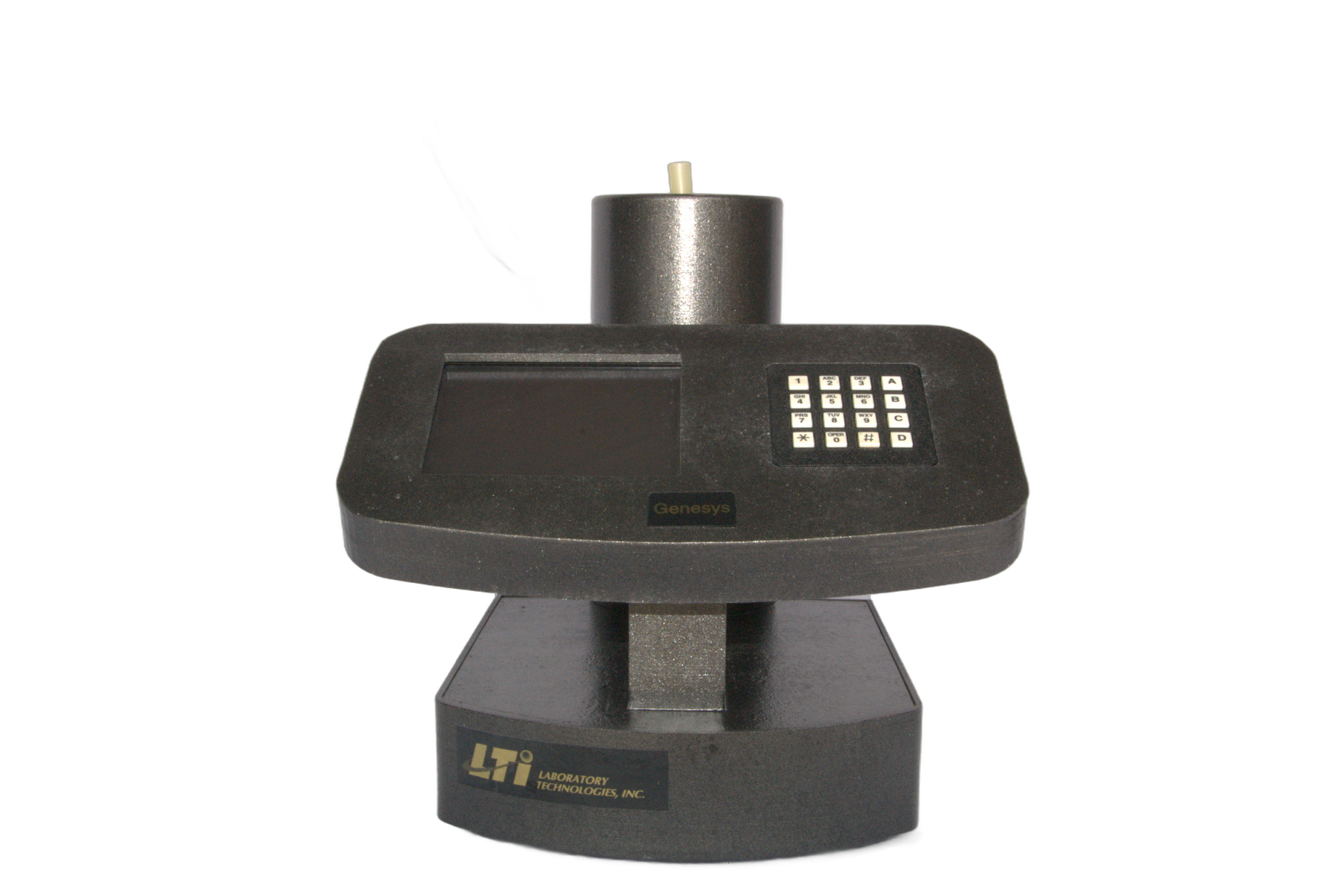
Since 1985, the Genesys Gamma 1 has been setting the single-well gamma counter standard — full assay library, decay-corrected Stored Curves, four decades of Genesys-platform refinement. The kind of engineering nothing else has matched. Still the one labs choose.
7× faster
Beats “automatic” counters 13 min vs. 109 min per panel.
Genesys Genii — parallel-detection runs a 100-tube RIA panel in 13 minutes. Serpentine-belt “automatic” counters take 109. The architecture, not the marketing, makes the difference.
One platform · Three configurations · Made in America since 1985
Genii vs. the Revvity Wizard²
13minvs.109min
A 100-tube RIA assay. Same panel, same output. Roughly 7× the time on the belt. Multiply across your year and the gap reads in weeks of bench time.
Live calculator below. Pre-filled with industry defaults; adjust to your lab’s real workload.
Selector
Not sure which Genesys is right for your lab?
Four questions about your isotopes, throughput, and priorities. We’ll point you at the right model — and show the time math behind it.
Or scroll down — the page covers what they all share, then breaks out the differences.
Built in America · Since 1985
One platform. Four decades of refinement. Three configurations.
Every Genesys counter — the single-well Gamma 1, the multi-well Genii Series, and the high-energy Genii HE — runs the same proven Genesys platform. Same software, same calibration model, same QC engine, same training — engineered in Elburn, Illinois, manufactured in the United States from high-strength materials, with no reliance on outside vendors for the firmware that runs the assay.
1/ 4
01
100% solid state
No moving parts, no carousels, no auto-changers, nothing to wear out. The most common source of downtime on competing counters — the mechanical sample changer — doesn’t exist in this family. Load the rack, press count, walk away.
02
No preventative maintenance
Our design philosophy: more than one service call per ten years of ownership is too much. The Genesys family delivers on that. No annual contracts, no PM windows, no shipping calendars. Many units in the field today have run for decades without a single service call.
03
Under 30 watts
Universal 100–240 VAC, 50/60 Hz, automatic. A Genesys counter draws less power than a desk lamp. Small footprint, low heat output, lives on a bench. No special outlets, no dedicated circuits, no facility planning.
04
Made in the United States
Designed, engineered, and manufactured at LTI’s Elburn, Illinois facility. The firmware was written by the people who answer the phone when you call for support. No outsourced engineering, no offshore software, no third-party vendors in the assay loop.
The Detector
Crystal mass below the well — where stopping power lives.
Gamma radiation is emitted in all directions, 360 degrees from the sample. Some manufacturers don’t seem to understand that — they minimize crystal mass below the well, which destroys efficiency at higher energies. Genesys detectors don’t do that.
1/ 4
01
NaI(Tl) crystal with deep stopping mass
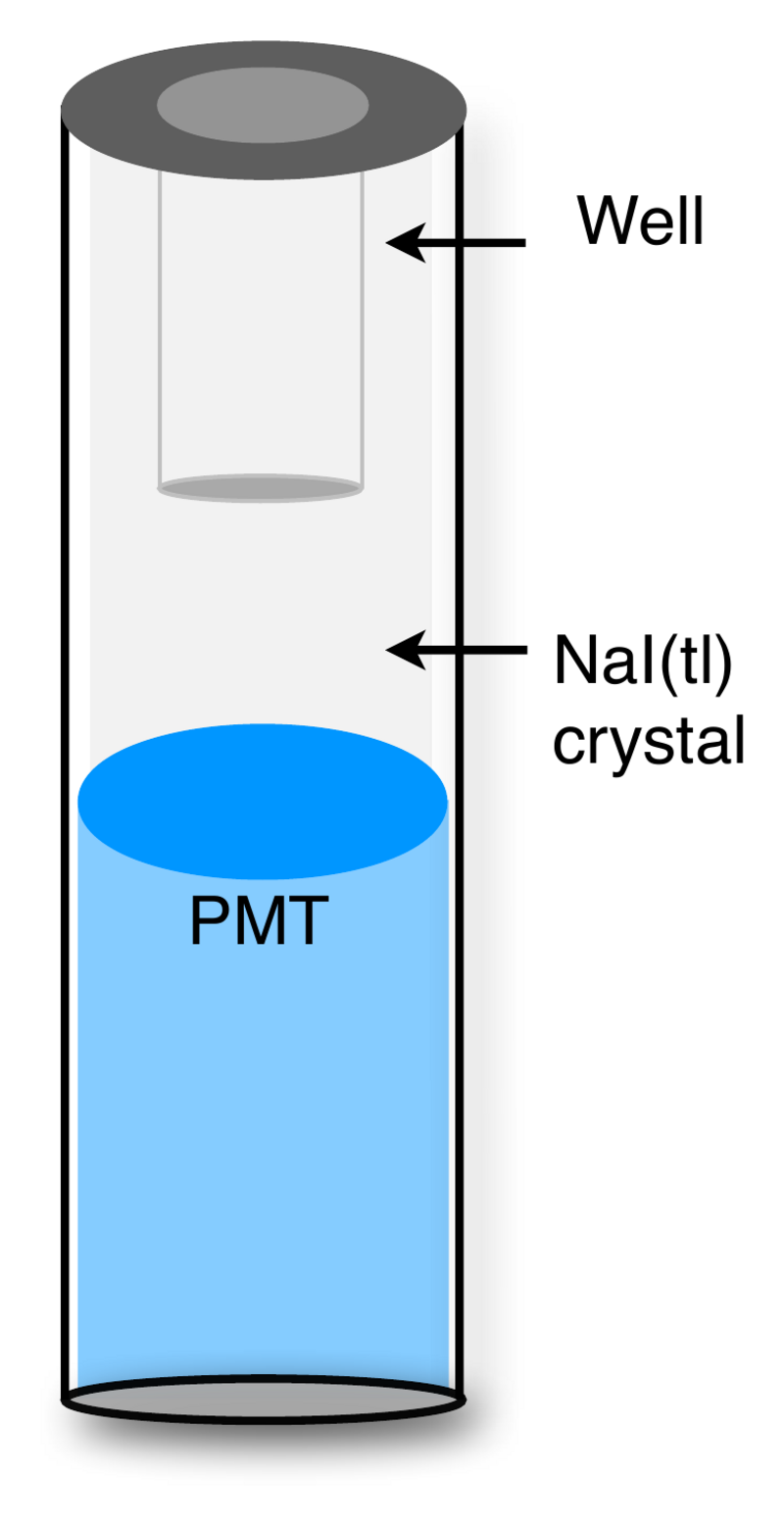
Asymmetric NaI(Tl) crystal with the bulk placed where it matters: ⅞″ of crystal directly below the well — 3.5× the depth Capintec leaves below their sample. Gamma radiation is emitted in all directions; minimizing crystal below the well destroys efficiency at higher energies. We don’t do that.
The result: > 80% efficiency for I-125 and Co-57 on the standard family. Well dimensions: 1.25" deep × 0.669" diameter — identical across all three models. Each well has a removable liner to protect the crystal from contamination.
02The part most manufacturers won’t name
We use Hamamatsu. Every detector. Every model. Every time.
The photomultiplier tube converts the crystal’s scintillation light into countable signal. Hamamatsu Photonics is the gold standard — the manufacturer specified by national labs, particle-physics experiments, and medical-imaging OEMs that can’t afford noise or drift.
Other gamma-counter manufacturers don’t publish whose PMTs they use. Take a guess why. If the PMT was something to brag about, they’d be bragging.
03vs. the Revvity Wizard (formerly PerkinElmer)
The Wizard’s wider crystal doesn’t do the work where it matters.
Revvity Wizard
1.26" diameter × 2" long crystal
Wider than ours, but shorter
Well dimensions: not published
Carrier-based loading requires a larger well to clear the carrier
PMT supplier: not disclosed
Genesys family
NaI(Tl) optimized for deep mass below the well
Well: 1.25" × 0.669" (published, identical across all three)
No carrier — direct sample loading keeps the well small and the crystal where it counts
Crystal mass below well: meaningfully greater
PMT: Hamamatsu Photonics
Side-wall mass is roughly comparable. But what counts at clinical-isotope energies — Co-57, Tc-99m, F-18, Cs-137 — isn’t side-wall mass. It’s mass below the well, where the down-going gammas need to interact. The Genesys puts the crystal where it works.
04
Lead shielding — sized per model
0.75"
equivalent
Gamma 1
0.85"
solid
Genii
1.125"
solid
Genii HE
Lower backgrounds mean lower minimum detectable activity (MDA) — you can see smaller samples sooner.
Well-to-well accuracy on multi-well Genii configurations: three layers of engineering.
The Genii Series ships in 2-to-10-well configurations. For assay work, every well has to produce the same result on the same sample — otherwise standards curves don’t mean anything. We get there with three independent layers:
Single-ADC multi-well architecture. One ADC handles all wells — the architecture Donald Oesterlin pioneered on the Genesys 5000 in 1985 and that LTI has refined for four decades. Eliminates the per-channel ADC drift that plagues counters with one ADC per well.
Physical detector gain matching. Detectors in a Genii configuration are matched by gain at the factory before assembly.
Software well normalization. A user-runnable procedure that counts a source in each well and computes per-well correction factors to mathematically equalize residual variation. Any consistent source works — calibrated standards are ideal, but an uncalibrated source is sufficient when all you need is well-to-well matching. Compensates for whatever physical matching couldn’t eliminate, and absorbs the effects of field detector replacement without sending the instrument back to LTI.
The combined result: assay reproducibility that doesn’t depend on which well the sample lands in. Add E-Lead™ crosstalk correction for the high-energy isotopes where lead alone isn’t enough, and the Genii Series delivers clean per-well data across the entire 0–1 MeV (Genii) or 0–2 MeV (Genii HE) energy range.
Best Value
The total-cost story stacks our way.
A gamma counter’s sticker price is the smallest part of its lifetime cost. Standards, calibration sources, service contracts, PM windows, and replacement parts add up. The Genesys family is designed to minimize all of them.
1/ 4
01
I-125 Self-Calibration — build your own calibrator from a tracer drop.
The Genesys deep-well NaI(Tl) detector and embedded firmware include a Self-Efficiency Check that uses the two-peak (28 keV main + summation) physics of I-125 to compute absolute DPM without a purchased calibrated source. A few microliters of tracer from any standard assay kit replaces a recurring source-purchase line item.
This applies to all three Genesys models — Gamma 1, Genii, and Genii HE. The savings continue for the life of the instrument. International labs that can’t obtain calibrated I-125 sources at all get a working efficiency-QC program out of the box.
User-performed automatic system calibration runs in minutes, on demand, with whatever source you have. No service truck, no shipping calendar, no “we need to take the instrument out of service for a week.”
03
No PM contract
Solid state, no moving parts, no preventative maintenance schedule. Most labs run a Genesys counter for a decade without a service call. The instruments at LTI’s Elburn facility include units shipped in the 1980s — still running, still supported.
04
Decades of dependable service
Owning a Genesys is a long-term investment. The current Genii, Gamma 1, and Genii HE inherit four decades of LTI engineering refinement, built on a platform proven across hundreds of clinical and research labs since the 1980s. Not a first-generation product, not a feature-of-the-month redesign — an instrument that’s been earning its keep since long before most of the technologists running it today started in nuclear medicine.
Ease of Use
Load samples. Press count. Done.
The Genesys family is built for the technologist who has actual work to do. Training is measured in minutes, not days. New employees, temporary help, cross-trained staff — running assays the same day.
1/ 6
01
Stored assays — named, configured, recallable.
Every assay is a saved configuration: name, isotope, count time, tube count, response units, X/Y axis scaling, curve fit, print options. Select an assay from the menu and the parameters load. No re-entering values, no rebuilding configurations.
Built once, run forever — until you change it.
02Stored Curve
Stored Curve — run standards once per kit lot.
Save the standard curve from an assay run. The Genesys decay-corrects it automatically and lets you re-use it on every subsequent day until the kit lot expires — no need to re-count standards every morning. Just run a QC sample to verify and you’re counting unknowns within minutes.
The math runs continuously: Display Stored Curve shows the curve with counts corrected for decay to the exact minute you use it. One restriction: the isotope must be from the same lot as the original curve.
Saves time. Saves standards. Saves money.
Unique to LTI
Revvity’s Wizard line does not publish or offer this. Stored Curve and Recall Counts have been Genesys-platform features since the Genesys 5000 (1985) — four decades of refinement on a workflow no competitor has matched.
03Recall Counts
Recall Counts — re-analyze without re-counting.
After a count completes, the raw tube data stays in memory. Recall Counts lets you run that same data through a different assay configuration — different curve fit, different response units, different reporting — without recounting the tubes.
Genii: full re-analyze of whatever’s currently in memory. Switch the math, keep the data. Gamma 1: a lighter version — recall the last assay counted, run it through new settings.
The use case: assay didn’t converge, kit insert was wrong, QC flagged a problem, or you just want to see the same numbers through a different lens. Recall lets you rerun the analysis in seconds without consuming another sample or another count cycle.
Unique to LTI
Revvity’s Wizard line does not publish or offer this. Stored Curve and Recall Counts have been Genesys-platform features since the Genesys 5000 (1985) — four decades of refinement on a workflow no competitor has matched.
04
Curve-fit options to match your kit insert.
Match the curve to the kit, not the other way around. Linear, log, or logit Y-axis. Linear or log X-axis. Curve fits: Point-to-Point, Straight Line (weighted/unweighted), Cubic Spline — plus 4-Parameter Logistic on the Genii and Genii HE, the industry standard for RIA/IRMA competitive-binding work.
Gamma 1: four standard fits (shown above). Genii / Genii HE: same four plus 4PL. If your kit insert specifies 4PL, spec a Genii.
05
Backgrounds per well + Levey-Jennings QC.
Each detector’s background is measured, tracked, and automatically subtracted on multi-detector configurations — with E-Lead™ crosstalk correction eliminating detector-to-detector interference even at higher energies.
Levey-Jennings QC charts update with every count. Detailed QC reports print on demand. Drift, bias, and out-of-control conditions surface immediately, not at the end of the month. The L-J chart plots the last 30 runs by default for trend analysis.
QC Crash: set a variance threshold; if QC exceeds it the assay halts for operator review before continuing.
06
Print or send — your choice.
Epson LX-350 dot-matrix printer — included with the Genii and Genii HE, optional with the Gamma 1. All three units ship with dual serial ports for RS232 to a computer or LIS.
Genii and Genii HE add a parallel printer port; optional USB-via-conversion-cable is available across the family. Dual data ports allow independent configuration — one to LIS, one to local printer, simultaneously.
Sample Reports
What a Genesys report actually looks like.
Most product brochures show a rendered UI mockup. We show you real scanned printouts — the same ESC/P 2 printer output your operators will see, the same column layout, the same MCA spectrum capture, the same pass/fail logic. The Genii, Gamma 1, and Genii HE all share the same firmware family and the same report format.
Every Genesys report carries the date and time stamp from the instrument’s internal clock, the test profile name, the configured count time, and the per-detector breakdown for multi-well configurations. The same format prints from every counter in the family — Genii, Gamma 1, and Genii HE — in DPM, CPM, Bq (decays per second), and nCi as appropriate to the report type.
Assay Summary — RIA Test Setup
The header report for an RIA assay run. TEST1, I-125, 1-minute count time, five standards with single-tube replicates, three QC tubes with duplicate replicates, plus the unknown bin. The cubic spline curve fit is selected with %CPM/HI STD as the response variable on linear X & Y. Three QC pools (QC 1 / QC 2 / QC 3) carry their own configured low and high limits, ready to flag any assay run that drifts outside tolerance. Stored Curve is saved automatically; the L-J QC log updates with every run.
TEST1 RIA assay · I-125 · cubic-spline curve fit · 3 QC pools with limits · LJ plots and stored curve enabled.
Isotope Library Summary — Per-Well Efficiency
The instrument’s record of an isotope’s identity and the per-detector efficiency the firmware has measured for it. Co-57, lot C00202WN, 90–170 keV window, normalized 05/06/02. The half-life is stored in days (271.700) and the firmware decay-corrects the calibrated DPM forward from the normalization date automatically — 228,182 DPM current from an initial 236,807 DPM. Per-well efficiency runs ~82–83% across the five wells with the normalization factor (NF) listed next to each — the basis for AutoSpect’s DPM calculation on every subsequent count.
Co-57, 90–170 keV · half-life-corrected current DPM · per-well efficiency, background, normalization factor · the basis for AutoSpect DPM on every count.
QC Display Table — Trend Log with Deviations
The chronological QC trend log behind every Levey-Jennings chart. For TEST1, all three QC pools (QC 1, QC 2, QC 3) plotted alongside their configured low / mean / high limits, with the most recent nine records shown here with their deviation values — positive or negative drift from the configured mean for that pool. Drift, bias, and out-of-control conditions surface in seconds, not at the end of the month, and the log auto-prints on demand or scheduled.
TEST1 QC trend log · three pools with per-pool deviation tracking · the chronological record behind every Levey-Jennings chart.
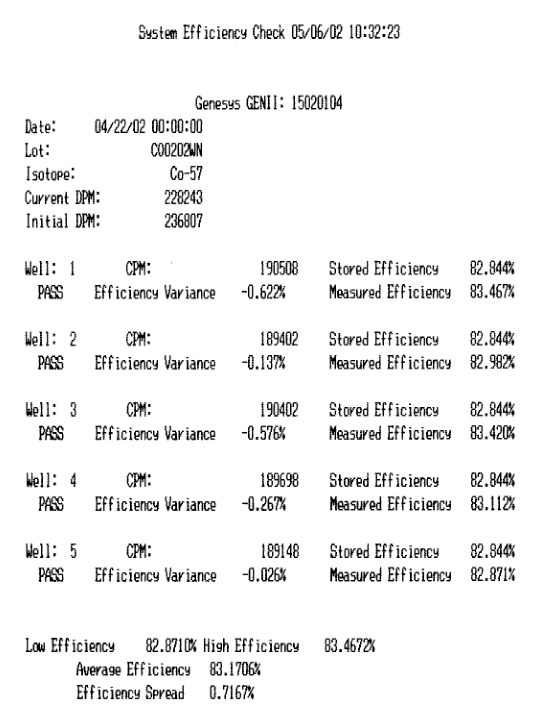
System Efficiency Check — Per-Well PASS / FAIL
The Genesys Genii reading every well of the configuration against the stored efficiency it’s expected to deliver. For Genesys GENII 15020104, Co-57 (lot C00202WN, 228,243 DPM after decay correction), five wells each report CPM, stored efficiency, measured efficiency, and the per-well variance. Anything beyond ±5% variance against the stored efficiency, or beyond 5% overall spread across the configuration, triggers a FAIL annotation in the report. This run: all five wells PASS with the worst variance at −0.622% and an overall spread of just 0.7167%.
One report format, four decades of refinement. The Genesys family produces documentation rich enough for clinical research records, GLP audits, regulatory inspections, and routine QA — out of the box, in the format your operators will print every day. Assay setup, isotope library, QC trend log, system efficiency check — the same printer, the same column layout, the same audit trail across every Genii, Gamma 1, and Genii HE shipped since the platform was first released.
Same platform — three standard models, plus custom.
You’ve seen what they share. Here’s where they diverge. Pick by what you count, how many, how high in energy — or build a fourth.
1/ 4
Unmatched in its class
01
Genesys™ Gamma 1
The only modern compact single-well RIA gamma counter still being manufactured at this form factor and quality tier. PerkinElmer / Revvity dropped their compact single-well years ago. No other major manufacturer makes one today. If you need a research-grade single-well RIA counter in 2026, this is effectively the only modern option — lower-volume RIA, tracer work, wipe-test follow-up, teaching labs, second-shift backup.
What’s different about this model
Detectors1 well
Energy range0–1000 keV
Curve fitsPP, SL, WL, CS — no 4PL
Lead shielding0.75" equivalent
RecallLast assay counted
Throughput1 tube / count cycle
Everything else — software, calibration, QC engine, Stored Curve, Recall Counts, training, service philosophy — is identical to the others in the family. If your team learns one Genesys, they know all three.
Most popular
02
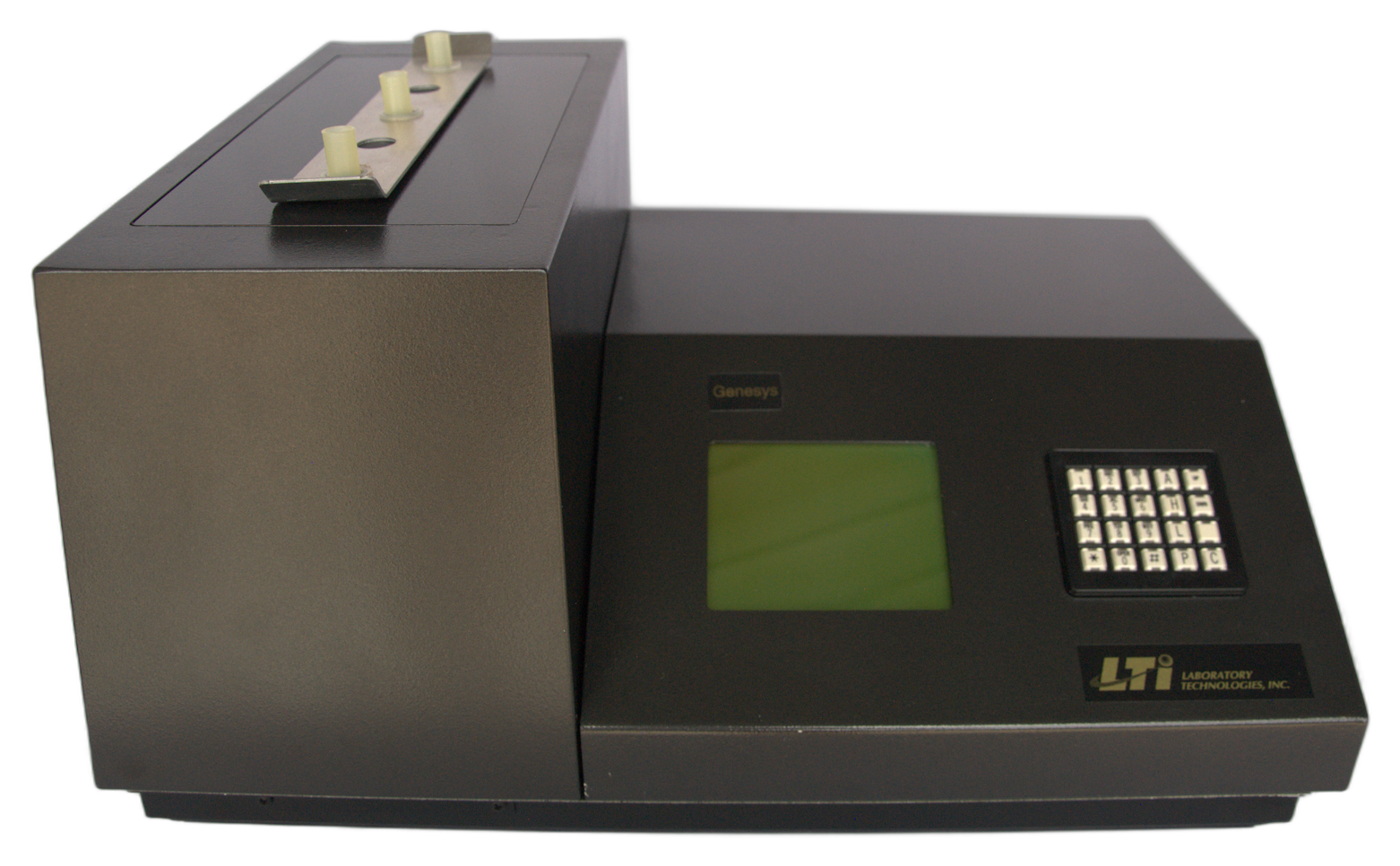
Genesys™ Genii Series
Multi-well parallel counting for RIA / IRMA labs running real volume. A 10-well Genii counts 10 tubes in the time a Gamma 1 counts one. The 4PL fit makes it the default for competitive-binding kit work.
What’s different about this model
Detectors2, 3, 4, 5, 6, 8, or 10 wells
Energy range0–1000 keV
Curve fitsPP, SL, WL, CS, + 4PL
Lead shielding0.85"
RecallFull re-analyze of memory
ThroughputN tubes / cycle (N = wells)
Everything else — software, calibration, QC engine, Stored Curve, Recall Counts, training, service philosophy — is identical to the others in the family. If your team learns one Genesys, they know all three.
03
Genesys™ Genii HE
High-energy multi-detector. The choice when your primary isotope emits above 1 MeV (Co-60, Cs-134, K-40, Ra-226 daughters) or when you need optimized mid-range 300–800 keV efficiency.
What’s different about this model
Detectors1, 2, or 3 × 2"×2" NaI(Tl)
Energy range0–2 MeV
Curve fitsPP, SL, WL, CS, + 4PL
Lead shielding1.125"
RecallFull re-analyze of memory
ThroughputN tubes / cycle (N = detectors)
Everything else — software, calibration, QC engine, Stored Curve, Recall Counts, training, service philosophy — is identical to the others in the family. If your team learns one Genesys, they know all three.
Engineering on demand
04
Custom Gamma 1
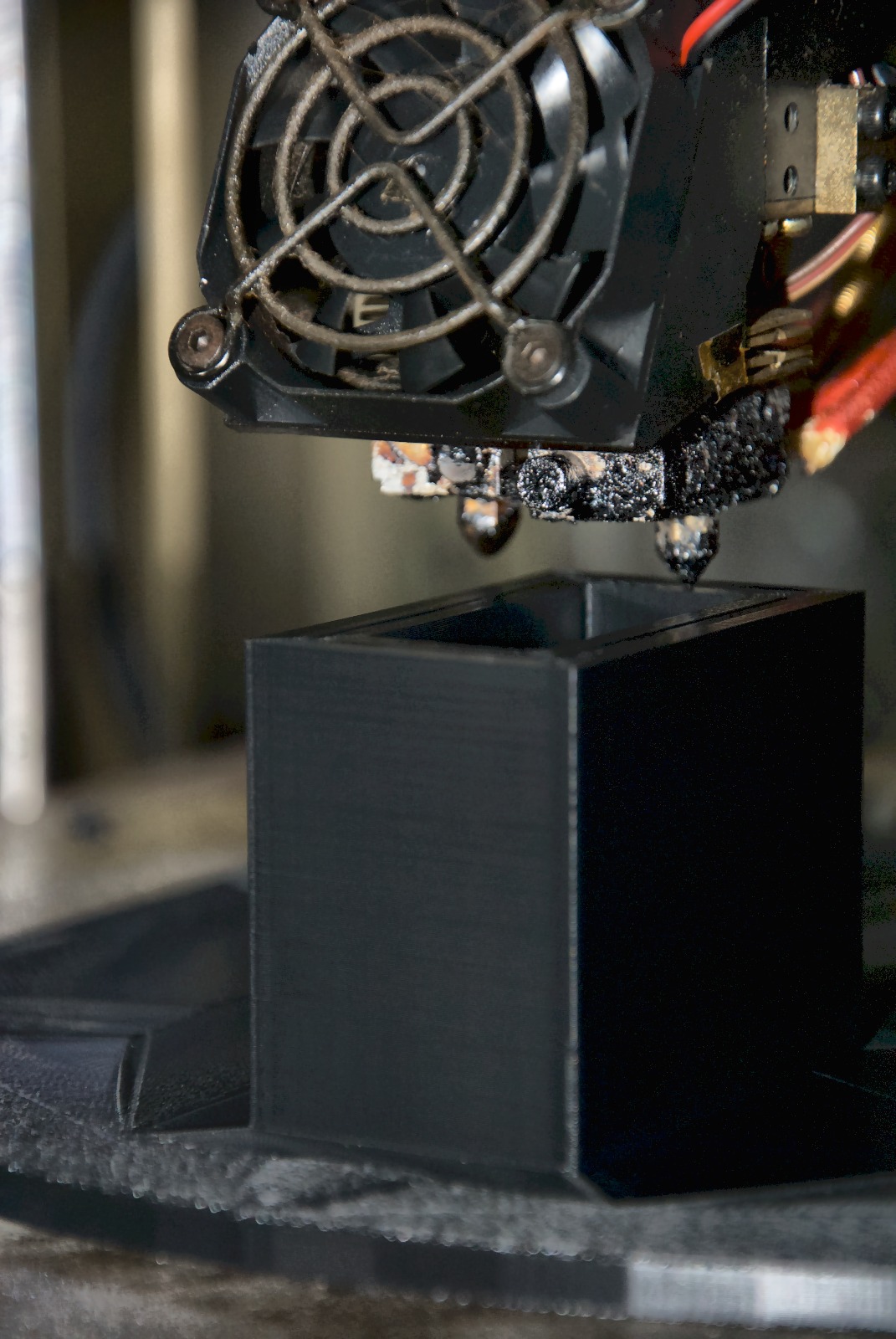
When the research workflow doesn’t fit a catalog SKU. Because the Gamma 1’s detector housing is additively manufactured in-house, a non-standard build is quoted as a CAD edit and a print run — not a tooling project. Most custom Gamma 1 instruments ship in weeks instead of months. Earlier in 2026 we built a customer a Gamma 1 chassis with a 2″ high-energy crystal — well under the price of a Genii HE.
What can be customized
DetectorLarger crystal, alternative material, HE chassis
Well geometryDeeper or differently-shaped for non-standard sample formats
ShieldingCustom envelope for high-background environments
Tell us the actual research workflow — the isotopes, the sample geometry, the assay protocol, the throughput — and we’ll tell you honestly whether a stock Gamma 1 fits, a custom build adds value, or a different instrument family is the right answer. Start a custom build conversation →
*Custom-housing flexibility applies to the Gamma 1 chassis only. Genii and Genii HE use traditional sheet-metal construction; software, library, calibration, and reporting can still be customized on those models independent of housing.
vs. the Revvity Wizard² (formerly PerkinElmer)
13 minutes versus 109 minutes.
A direct comparison of the LTI Genesys™ Genii against the serpentine-belt Wizard² on a 100-tube RIA assay run — and the architectural decisions behind the time difference.
1/ 4
01
Same panel. Same output. Roughly 7× the time on the belt.
Both instruments run the same 100-tube RIA panel: standards, controls, unknowns. Both produce the same output — fitted standard curve, calculated unknowns, printed report. The difference is in how samples move through the detectors during the count.
At 2 panels/day, 5 days/week: ~690 hours/year reclaimed.
The technologist’s hands-on time is similar between the two — ~11 min Wizard², ~13 min Genii. What separates them is the ~98 minutes of mechanical interchange time on the Wizard² that the tech isn’t directly working on but isn’t free to walk away from either. The instrument is occupying its bench, the panel is in process, and the lab is waiting on a standards curve before it can release results.
A note on the industry term: instruments like the Wizard² are marketed as “automatic gamma counters.” The belt is automated; the workflow is not. 109 minutes per panel with the technologist tethered to the bench isn’t what “automatic” should mean to a working lab.
02
The 7× gap isn’t a software difference. It’s an architecture difference.
Parallel detection — the Genii approach
The Genii assumes the cost-driving constraint is throughput. 10 tubes counted simultaneously eliminates sample-interchange overhead entirely between cycles. 10 tubes in, count, 10 tubes out, 10 more in.
No moving parts. The operator does the loading; the array does the counting. Trade-off: upper bound of 10 wells per chassis. For panels above 1,000 tubes/day, additional Genii instruments scale linearly — multiple counters running in parallel without complex automation.
Serpentine-belt sequential lift — the Wizard² approach
The Wizard² assumes the cost-driving constraint is detector cost. A small number of detectors handle a much larger sample queue via mechanical interchange. The belt and lift mechanism trade time for hardware: fewer detectors, longer total run time.
Trade-off: total throughput on a single panel is limited by belt speed, not detector capacity. Mechanical motion comes with a maintenance footprint — periodic adjustment, lubrication, tensioning, eventual wear of belt and lift assemblies.
Vocabulary check — “automatic”: The industry markets these instruments as automatic gamma counters. The mechanical sample transfer is in fact automated — but the workflow it produces is not what most operators mean by “automatic.” 109 minutes of clock time per 100-tube panel, with the operator still doing the loading and bound to the bench for the unload, is not hands-off operation in any sense that matters to a real lab schedule. True automation, from the operator’s seat, means the assay gets done fast — not that a belt does the moving. By that standard the Genii’s parallel-detection workflow is the more automatic instrument: 13 minutes start-to-finish, with unloading integrated into the rack swap.
Vocabulary check — “robotic”: The Wizard² is sometimes called a “robotic” gamma counter. The mechanism is more accurately a serpentine belt with a sequential sample-lift — not a pick-and-place robotic arm. The distinction matters when reading product literature, because the engineering trade-offs are different from a true pick-and-place system.
03
The 96-min-per-panel savings is the headline. The TCO story adds three more.
1
Preventive maintenance
The Genii is fully solid-state. No moving parts. No belts. No lifts. No rails to lubricate. The Genii’s preventive maintenance program is, essentially, a daily background and check-source routine. There is no scheduled annual PM, no service contract requirement, no factory-recommended belt replacement at hour intervals. Ask any serpentine-belt vendor for a quote on a one-year service contract. The contrast tells the story.
2
Calibration sources
The Genii (and the Gamma 1) calibrate I-125 efficiency directly from the I-125 tracer in any standard RIA assay kit. No separate calibrated I-125 source needs to be purchased, stored, decay-tracked, or replaced — and a calibrated I-125 source costs hundreds of dollars on a roughly 60-day half-life replacement cycle. Across the operational life of an instrument, this single feature saves a typical RIA lab thousands of dollars in source-purchase costs.
3
Market-access angle
For international labs — Asia in particular — calibrated I-125 sources can be impossible to obtain. Regulatory restrictions, supply chain issues, customs complications, or the simple absence of a local distributor leave many overseas labs with no path to efficiency-calibrated I-125 work at all. Without the kit-tracer method, those labs cannot run efficiency QC on their primary RIA isotope. The Genii’s tracer-based calibration isn’t a cost saving in that context — it’s the difference between having a working QC program and not.
04
The honest both-sides view.
This is a comparison, not a takedown. The Wizard² is a competent instrument with a long installed base, and there are situations where its architecture is the right answer. Here’s the fair frame for both:
When the Wizard² makes sense
Very large per-panel sample counts beyond 500 tubes per run, where walk-away automation outweighs single-instrument run time
Highly heterogeneous sample queues where the operator loads a long mixed-priority queue and lets the instrument chew through it without intervention
Existing investment in Wizard² consumables, racks, and protocol templates where the institutional cost of switching outweighs the per-panel time savings
When the Genii makes sense
Per-panel turnaround time matters — especially for STAT samples or short-cycle research panels
Calibration source budget is a real concern — the I-125 tracer story alone justifies the platform for many RIA labs over the life of the instrument
I-125 calibrated sources are difficult or impossible to obtain in your market
Minimal preventive maintenance is a priority — solid-state, no moving parts, no service contract requirement
RIA / IRMA / receptor-binding research work — the Genii is positioned and supported as a research-grade instrument
How does the Genii really compare to an “automatic” gamma counter?
Serpentine-belt counters — sold by the industry as “automatic gamma counters” — use a vertical lift mechanism that transfers each tube from a sample belt into its detector well, holds it for the count, lifts it back out, and indexes the belt to the next position. The belt is automatic. The workflow it produces is not. The Genii is built differently. The operator slides a rack of ten tubes into the bay, the instrument counts all ten in parallel, the operator slides the next rack in — and as each rack finishes, the operator simply flips it over a waste container and inserts the next. Unloading is integrated into the workflow, not deferred to a separate end-of-assay phase. When the last tube finishes counting on the Genii, the operator is done. When the last tube finishes counting on an “automatic” counter, the operator still has to clear the deck. The math below is what that workflow difference is actually worth — in time, in labor, and over the lifetime of the instrument.
Your assumptions
Pre-filled with reasonable defaults for an RIA-style assay schedule. Adjust to match your lab.
Mode A — vs. single-detector “automatic” counter. A single-detector serpentine-belt counter (marketed as an “automatic gamma counter”) handles one tube at a time: lift from belt, count, lift back, index belt, repeat. For a 100-tube assay that adds up to about 109 minutes of clock time vs. the Genii’s 13 minutes — the workflow that built our reputation in the 1980s and 1990s.
Your results
Recalculates as you type. The bar chart shows clock time per assay; the tiles show the annual and lifetime impact.
10-well Genii
— min
Single-detector “automatic”
— min
Time per 100-tube assay, start to finish — loading, counting, unloading, and curve edit. On the Genii, unloading happens inline as you swap racks; on a belt-driven “automatic” counter, it’s a separate post-counting phase before the next assay can begin.
Time saved per assay—min— faster
Hours reclaimed per year—hrs/yrtechnologist time freed for other lab work
Annual labor value reclaimed$—at the rate you entered, every year
Lifetime ownership cost saved$—purchase delta + service contracts avoided
Total advantage over the ownership window$—
Reclaimed labor + lifetime cost difference, summed across the years you entered.
Like what you see?
Send me a formal quote
We’ll build a quote around the configuration you’ve modeled above — well count, isotope range, optional accessories, and any RIA-specific options. No sales pressure.
Thanks — got it.
Someone from LTI will be in touch within one business day with a formal quote built around your configuration.
Show me the math — how these numbers are calculated
Every line below uses the inputs you entered above and the comparison mode you selected. Change any input or switch modes and these numbers update.
Step 1 — Time on the Genii (per assay)—3 minutes overhead (rack handling + curve edit) plus 1 minute per rack of 10 tubes (60 sec parallel count + ~10 sec manual rack swap).
Step 2 — Time on the “automatic” counter (per assay)—11 minutes hands-on (load 100 tubes into racks, racks onto deck, edit curve) plus per-tube counting and sample-interchange time.
Step 3 — Time saved per assay—Step 2 minus Step 1.
Step 4 — Hours reclaimed per year—Time saved per assay × assays per week × weeks per year, converted to hours.
Step 6 — Purchase price advantage—Genii is approximately half the cost of a comparable belt-driven “automatic” counter. The dollar figure is computed against the “automatic”-counter price you entered.
Step 7 — Service contracts avoided over ownership window—“Automatic” counter price × service contract % × years owned. The Genii has no scheduled PM contract requirement.
Step 8 — Total advantage across the ownership window—Reclaimed labor (Step 5 × years) plus purchase advantage (Step 6) plus service avoided (Step 7).
These are estimates based on industry-typical assumptions. Final numbers depend on your isotope, count time, lab schedule, and quoted price.
Methodology: A 60-second count time per tube is assumed. Genii cycle = 60 sec count + ~10 sec manual rack swap (10 tubes counted in parallel). Single-detector belt-driven cycle = 60 sec count + ~6 sec sample interchange (1 tube at a time). 10-detector belt-driven cycle = 60 sec count + ~35 sec interchange (10 tubes counted in parallel, but loaded and unloaded sequentially by a vertical lift mechanism along the serpentine sample belt). All time figures are start-to-finish, including rack/tube loading, unloading, and curve editing. Important workflow note: serpentine-belt counters — the instruments marketed as “automatic gamma counters” — require a separate ~4-minute end-of-assay unloading phase (3 min to remove tubes from racks + 1 min to remove racks from the deck) before the next assay can begin. On the Genii, unloading is integrated into the rack-swap cycle — by the time the last tube finishes counting, every previous rack is already dumped and put away. The “operator-finished” time is therefore meaningfully shorter than the “instrument-finished” time on a belt-driven counter, and identical to it on the Genii.
Tech Specs
The numbers, side-by-side.
Engineering specs across the family. Cells highlighted where a model diverges from the others; rows that span all three are identical.
Spec
Gamma 1
Genii
Genii HE
Detectors
1 × NaI(Tl) well
2/3/4/5/6/8/10 × NaI(Tl) wells
1, 2, or 3 × 2"×2" NaI(Tl)
Well dimensions
1.25" deep × 0.669" diameter — identical across all three
Photomultiplier tube
Hamamatsu Photonics — every detector, every model. Industry gold-standard PMT.